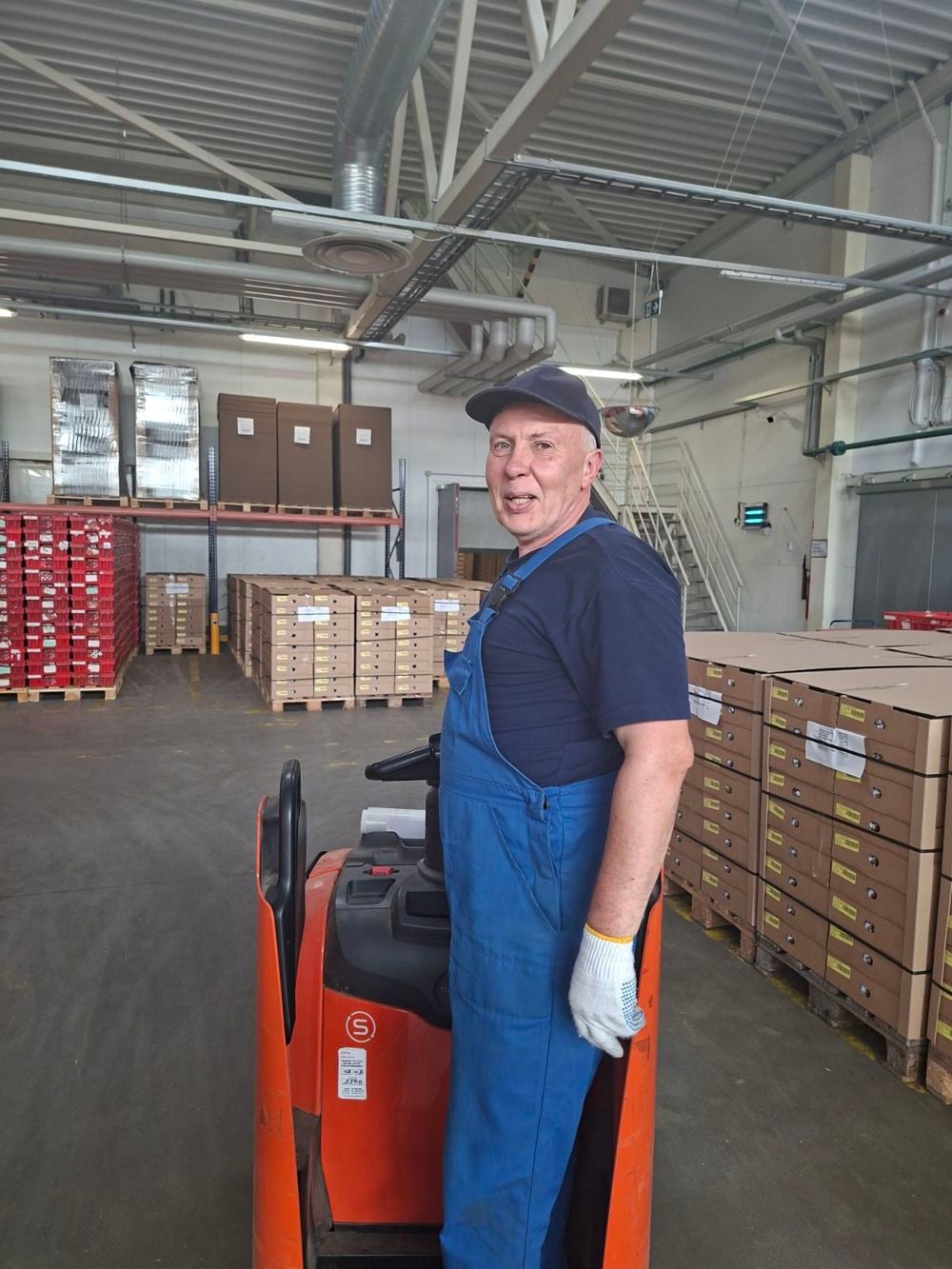
Gintaras Kondratavičius: 11 years with Vilniaus duona and aiming to stay until retirement

Gintaras Kondratavičius joined Vilniaus duona’s bakery in Vilnius after a period away from the workforce. Having spent several years caring for his elderly mother, he was looking for an opportunity to return to work. His neighbours had long-standing ties with Vilniaus duona, dating back to the time when the bakery was still located in the Konarskis area.
Gintaras, how did your journey with Vilniaus duona begin?
I had worked in the food industry before, mostly with meat products. But life took a different turn and for several years I had to devote my time to caring for my ageing mother.
Later, when I was ready to return to work, I started asking around. I live near the Konarskis area, where the Vilniaus duona bakery used to be located. One of my neighbours worked there and told me they were looking for people. So I decided to give it a try.
What kind of job did you start with?
I started as a packer and then spent a few months in production. After that, I moved into internal transport and logistics.
By training, I’m an electronics and mechanics specialist and I graduated from vocational school. I’ve worked in manufacturing, retail and restaurants over the years.
Now I work in the dispatch department. Apart from a short break, 30 September will mark 11 years since I joined the company. My official job title is electric pallet truck and forklift operator.
What does your job involve, and what qualities do you need for it?
You need to be attentive and physically strong. Everything else can be learned. I’m also licensed to operate an electric forklift.
I work as a loader and transport operator, but after so many years I’ve learned how to do almost every job in the bakery. Sometimes someone is ill or on holiday and you need to step in. Bread still has to leave for the stores on time — you can’t exactly leave the shelves empty.
If you know what needs to be done, there’s always work to do. Nobody needs to point it out to me — I just get on with it.
Is that how your day starts?
When I arrive early in the morning, the first thing I do is check the production lines and go through the plans prepared by Tadas. I need to know what is being baked where, because we supply not only Lithuania, but also Latvia and Finland.
You need to know which products are running on which lines, where they are going and in what quantities. If you want to do the job properly, you have to understand the whole picture, because we have around 120 different bakery products.
I check what needs to go to the Panevėžys bakery and what is being sent to Riga. I prepare the equipment, write down what needs to go where, how much product we can dispatch and how much is left. Then I pass that information on to the shift supervisor.
I also move pallets of bread to the right areas depending on where they are being sent. There are a lot of details to keep track of — you need to know the different types of bread, where they are going, when they need to leave and in what quantities.
What does your work schedule look like?
Usually it’s two day shifts, two days off, two night shifts, then another two days off. Sometimes we adjust the schedule if someone is ill or on holiday.
After a night shift, when I get home, I always try to get at least two hours of sleep straight away. My body clock finds night shifts harder.
But having days off during the week also has its advantages. You can take care of errands while everything is open — go to Sodra, visit the doctor, sort out whatever you need. That’s harder to do at the weekend.
Do you still need to buy bread, or do you get enough of it working at a bakery?
I get enough here. Every day we can take home two loaves through the security checkpoint. And when needed, I’m the one who brings them there.
So you must have tried pretty much everything you make. Which bread is your favourite?
I like Vilnius black bread, and I’m also very fond of the dark Agota bread.
So some of your favourites are actually baked at the Panevėžys bakery. Does that mean you don’t get to taste many rye products made in Vilnius?
We taste everything. We also bake rye-based products in Vilnius — wholegrain bread, protein bread and portioned breads at Toste.
We now have a new line for portioned breads, and a large share of that production goes to export markets.
You’ve been here for many years, and as you say, the work isn’t easy. What has made you stay for so long?
I like the people. The managers are good. You can talk things through, and if needed, the schedule can be adjusted.
I get along well with people and there isn’t much negativity. Of course, there are always things that could be improved or changed, but overall, the positives win out.
Do younger people come to work here as well?
They do, but I’ve noticed that people in their forties and older are often more interested in staying for longer. Their attitude tends to be different.
Of course, we also have very motivated younger colleagues.
You say the job takes physical stamina. So I guess you get a workout at work too?
I tell the girls they don’t need any body-shaping workouts — you get plenty of exercise here.
You do need strength for my job: moving pallets, pulling them, arranging them. Your muscles are working, you’re constantly on the move — this definitely isn’t sitting in front of a computer all day.
But I still exercise outside work. I go swimming at Impulsas.
I played handball for ten years and trained under a coach from Granitas. I’m still interested in basketball, football and ice hockey — I’ve always liked team sports.
Just this weekend I went to see Vilnius Žalgiris play Banga from Gargždai.
You go swimming — what else do you like to do in your free time?
I don’t think life should revolve around material things. I go to sports events, restaurants and concerts. We’re not going to live for 300 years, after all.
You have to get away sometimes, rest, take a holiday. I try to enjoy life to the fullest.
Would you say your job is difficult?
The work isn’t easy, but what job is? Some people have it much harder.
Is being a surgeon easy? One mistake there can cost someone their life. Here, if you make a mistake, you might end up with a batch of defective products.
Is it easy for our drivers? They get up in the middle of the night so that our bread reaches the stores.
Musicians play, painters paint, and we bake bread.
If you look for the positives, life is easier. If you look for the bad, you’ll find it. If you look for the good, you’ll find that too.
So, are you planning to keep working with bread for a while yet?
I enjoy going to work. If my health allows, I’ll keep working with bread until retirement — and maybe even after retirement.
I’m still physically strong. And retirement isn’t that far away now — about five years.
P.S. True to his caring nature, Gintaras called me after the interview to remind me that Vilnius Žalgiris would be playing Telšiai Džiugas on Sunday. I had mentioned that my husband also likes taking the children to watch football.
It is perhaps no coincidence that Gintaras was chosen as a Drive Value Ambassador for his quick problem-solving and willingness to support the team.